


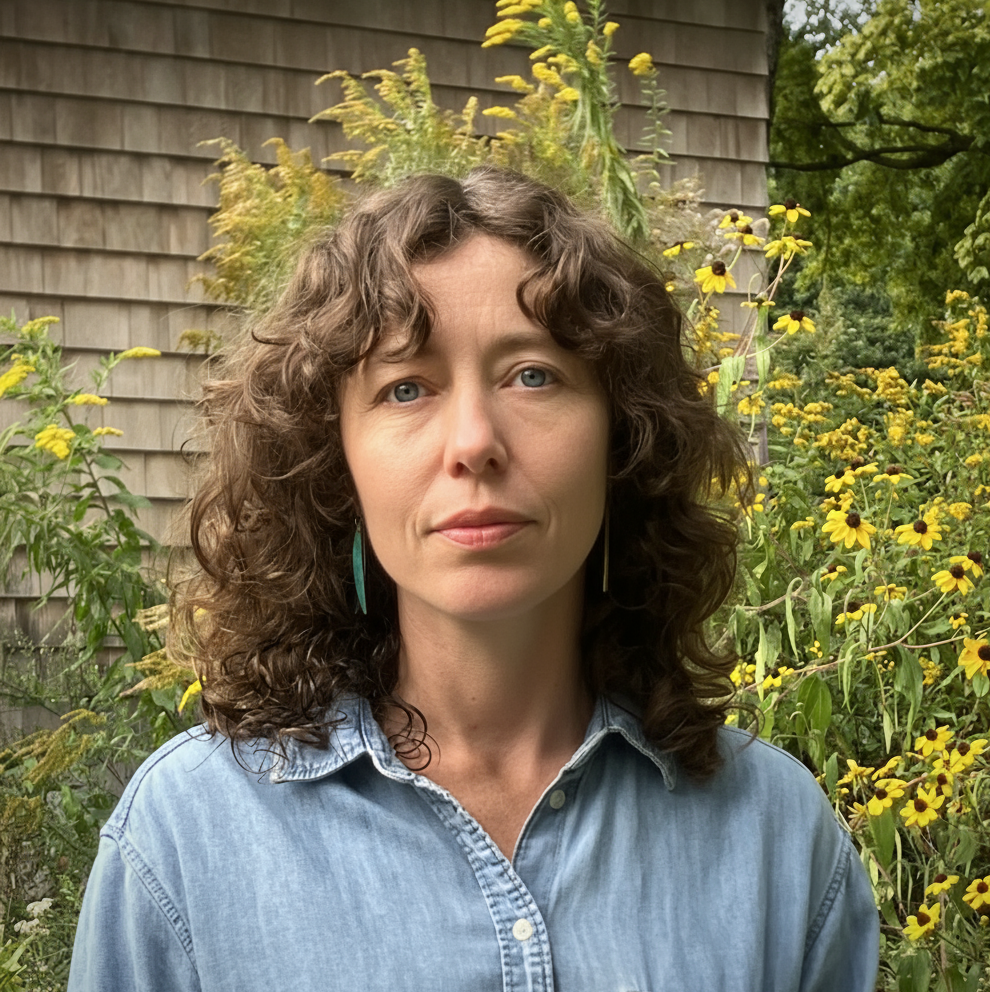

A midcoast entrepreneur who launched her food company in 2022 has a new Maine-specific product that she hopes will help her business expand into more stores and kitchens through the region
Ger Liang Tysk, the owner of Belfast-based Red Kettle Foods, released a new Maine kelp kimchi this month, adding to her roster of Asian ferments that include Japanese pickles, a Chinese chili relish, and several other kinds of kimchi. The kelp kimchi, billed as a 100% organic product, is made with napa cabbage and sugar kelp grown by Hancock-based Maine Coast Sea Vegetables.
A child of Hong Kong immigrants who grew up in Texas, Tysk says the kimchi is an example of how her business ties many of the threads in her personal and professional life together.
“This kimchi I’m making is a Korean food but it’s being made with ingredients from Maine,” she said. “It’s Asian and it’s American and it all comes together. It’s me.“
Tysk moved to Appleton around three years ago and started her business soon after. Today, the company sells its products at the Rockland and Belfast farmers markets, in dozens of grocery stores from Maine to Massachusetts, and to local restaurants like the Uproot Pie Company and Spark Bagel.
Going into the kimchi business has meant approaching food a bit differently than Tysk was used to. She’d always made kimchi to her taste, but had to adapt it to meet state regulations. She also had to shift her mindset from a chef making food directly for a handful of people to a manufacturer whose products have much wider reach. She had to learn about packaging, logistics and cold chains.
Red Kettle Foods’s most popular product is its classic napa cabbage kimchi. Kimchi, which can be made from a range of salted and fermented vegetables, is a mainstay of Korean cuisine.
“I can’t say that this is my mom’s kimchi or my heritage,” she said.
But she says that kimchi is also part of a broader Asian American culinary tradition, one she was part of growing up in Houston.
“It can be hard to find people that look like you, so you latch onto the Anime which is Japanese or the kimchi which is Korean, or the pho which is Vietnamese,” she said. “But it all comes together in the melting pot of Asian American food.”
Tysk’s path to midcoast Maine was more winding than most. Since growing up in Texas, she has worked an array of jobs in multiple time zones: she’s maintained military aircraft in Japan, been paid to dress up as anime characters as a professional cosplayer, and sailed on tall ships as a mate and cook.
Tysk went to college through the ROTC program and ended up being stationed at an Air Force base in Tokyo, where she lived for three years.
When she came back to the U.S. she found work at a library in Texas and tried to figure out what to do with her life. Then she listened to the audio book of “Moby Dick.”
She was captivated. She started to immerse herself in maritime history and came across a figure that would become a lodestar in her life: Nakahama Manjiro. Also known as John Mung, Manjiro was a fisherman at a time when Japan was still closed to the outside world. He was blown out to sea in 1843 and rescued by a whaling boat out of New Bedford, Mass., becoming the first Japanese immigrant in the U.S.
Manjiro lived an extraordinary life, later mining gold in California and then sailing from Hawaii to Japan where he worked as a negotiator and translator for the Shogunate. He played an instrumental role in reopening Japan in 1854 after the country spent 200 years in self-imposed isolation.
“I live my life trying to figure out what he would do in my shoes,” she said. “I feel like I’m kind of him in a way.”
Inspired by Manjiro, Tysk moved to the Boston area in 2007 and started working on tall ships. She published a novel based on Manjiro’s life and a book of photographs that chronicled his journey from Japan to the U.S.
At first Tysk worked as a deckhand but eventually moved into the galley. She taught herself to cook in the confines of a ship kitchen, where space and ingredients are limited and conditions are challenging. Everything has to be secured so it doesn’t fall on the floor. Some boats don’t have refrigerators; others have no oven. She would go long stretches without being able to procure fresh produce.
“I learned to cook very lean and with whatever ingredients we had,” Tysk said.
Tysk started making kimchi to liven up the menu, and because she was homesick. It turned out to be an ideal food for long sailing trips – because it’s fermented, it keeps better than fresh vegetables and doesn’t require refrigeration. And it was popular.
“People were like, ‘You should sell this, it’s really good.’” she said.
At the end of 2020, when she was asked to help sail a ship to the Virgin Islands, she met the captain of the boat in Charleston, South Carolina. They fell in love and, after sailing together for two years, moved to Maine, where he owned a house in Appleton.
Tysk soon tried her hand at selling her kimchi. She started out tiny, making a couple of jars a month, and quickly realized that her startup costs were going to be significant if she was going to go any bigger than selling direct to consumers from her home.
She found work in restaurant kitchens, and put every extra dollar into a savings account until she had saved enough for three months of business expenses.
After founding Red Kettle, she quickly grew out of her first space in Rockland. In 2023 she moved to the Crosby Center, a converted school building in downtown Belfast, but now is outgrowing that space, too.
As her business has expanded, she also has made connections with Maine’s broader Asian community through food. She’s on the planning team of the Maine Night Market, an annual market featuring Asian foods and producers. And she’s working with the organizers of a new Asian American Community center in Westbrook, which is spearheaded by Cambodian, Chinese and Filipino community groups.
To help Red Kettle grow, Tysk took part last year in Top Gun Bangor, a startup accelerator program run by Upstart Maine that provides entrepreneurs with training and mentorship as they scale. One of her goals is to get her products into more grocery stores on the East Coast.
And she may even dip a toe back into the restaurant world. She recently held a packed popup dinner in Camden and hopes to do more. And she dreams of opening a restaurant someday, serving up simple, homey dishes that are harder to find in Maine, like kimchi stew, rice porridge and scallion pancakes.
“I like to see people eating my food,” she said.