


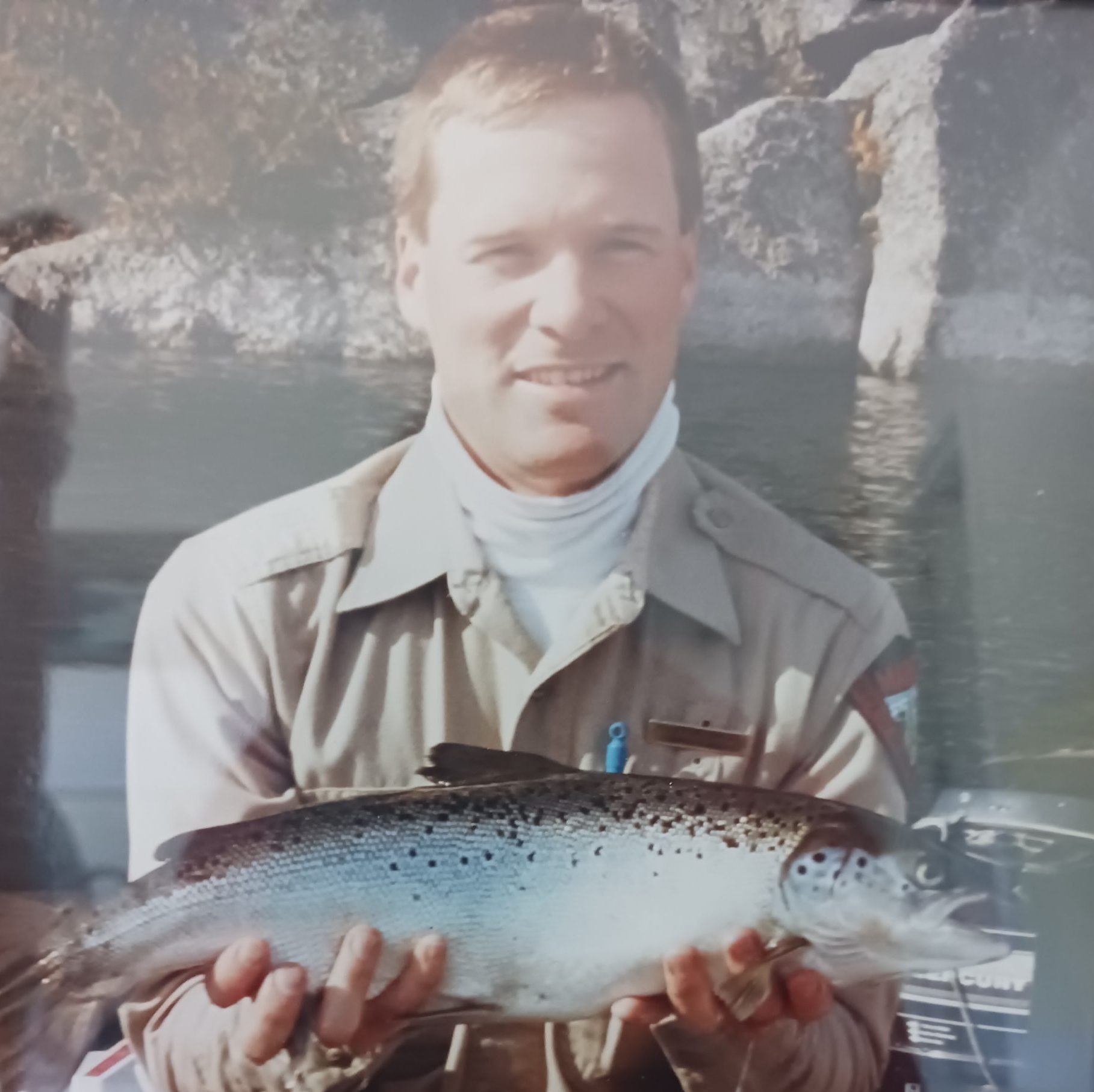

On July 17, 1939, Baxter State Park’s first ranger began searching Mount Katahdin for a lost 12-year-old boy from New York.
That ranger was my grand uncle.
I was reminded of that story recently when I saw the film “Lost on a Mountain in Maine.” The producers did a wonderful job telling a story I have known since I was very young.
The book of the same name held deep significance for my family because one of our own helped search for Donn Fendler on Katahdin that summer.
My grand uncle Richard “Dick” Holmes was a smart and humble man who loved the outdoors and navigating its wildness.
We shared the same hometown on Mount Desert Island and, not surprisingly, grew up doing many of the same things island boys do: fishing on the lakes, ponds, brooks and streams and on the ocean, hunting sea ducks on the offshore ledges and traveling off-island to hunt deer. We ice skated and cross-country skied in the winter and hiked the mountains of Acadia National Park in the spring, summer and fall.
But Dick was a rare breed, taking his passion for the outdoors to a level few ever reach.
One family story tells of his fascination at age 13 with navigating the rugged wilderness by compass. One day in the mid-1930s, he took his compass and backpack and struck out from Camp Roosevelt, the Boy Scout camp on Fitts Pond in Clifton, heading for the family camp on the eastern side of Beech Hill Pond in Otis.
The trek through the wilderness was at least 15 miles.
The camp’s director was confident he would make it safely, but my great-grandparents were frantic when they arrived at Camp Roosevelt and learned what he had done. Back then, there were only a few camps on Beech Hill Pond and the woods between the pond and the Airline were remote and mostly uninhabited. The terrain was thickly forested and bouldery and not easy walking.
But Uncle Dick completed the trip in just two days, spending one night on Mountainy Pond while my great-granddad maintained a bonfire on the beach in front of camp to help him find his way home.
Following his love of nature, he went to the University of Maine in 1935 to study forestry. He graduated in 1939 with his degree.
In the late winter of 1939, Dick and four friends set out to ski and camp on Mount Katahdin to celebrate their upcoming graduation. They arranged to use the Forest Service cabin at Chimney Pond through Bob McKay of Millinocket. When they stopped to pick up the key, McKay mentioned that the newly formed Baxter State Park was hiring its first ranger.
The five friends left the McKays and skied 15 miles from the dike at Millinocket Lake to Roaring Brook at the foot of the mountain, all the while contemplating whether to apply for the job. They took turns breaking trail to Chimney Pond, tying small ropes to the bottoms of their skis for traction on the 3-mile climb to the cabin. They arrived after dark.
The next morning, they were rewarded with one of the most spectacular views of Katahdin’s Great Basin and glacial cirque, rising more than 2,300 feet in a sheer wall of rock from Chimney Pond to Pamola Peak.
A driving snowstorm blew in and the group spent the day skiing in deep powder. By the time they left the cabin the following day, 30 inches of new snow had fallen, nearly burying the lean-tos. On the trail down, they skied along Roaring Brook as far as the Basin Ponds to avoid the Forest Service telephone wire, which hung only a few feet above the snow.
After that experience on the mountain, Uncle Dick decided he wanted the ranger job and set his sights on securing an interview. Shortly after the ski trip, he traveled to Augusta and met with the three members of the Baxter State Park Authority: Chairman and Attorney General Franz Burkett, Waldo Seavy, commissioner of forestry, and George Stobie, fish and game commissioner.
That afternoon he drove to Mount Vernon to meet former Gov. Percival Baxter at his home. He later said the interviews went well, and he was offered the job, which paid $100 per month.
In early June, he packed his meager worldly possessions into a 1929 Model A Ford and left his hometown of Northeast Harbor. His home for the season was the campground at Katahdin Stream, where he lived in a canvas tent as the park’s first and only ranger. His primary duties included clearing blowdowns from trails and campsites, assisting visitors and watching for wildfires.
On July 17, he received word that a 12-year-old boy from Rye, New York, had become lost while climbing the mountain with his family. The weather was cold and windy.
Dick started up Katahdin at 7 p.m. with five volunteers to begin the search for Donn Fendler. They found no sign of him on the Tableland or the Hunt Trail, where he had last been seen. They also searched the Saddle Trail to Chimney Pond, but he was not there.
The next day, Dick helped organize a massive search effort, with as many as 600 people scouring the mountain and its base.
Eventually, young Fendler had hiked away from the mountain, first heading north and then south. On the ninth day, he reached the East Branch of the Penobscot River, where his cries for help were heard by Nelson McMoarn, who maintained Lunksoos Camp.
Listening to this story as a child was always fascinating to me, and seeing the movie brought back many memories, especially watching part of a real-life interview with Uncle Dick. I know some people were critical of the Hollywoodized scenes and inaccuracies, including animals that did not exist in the park at the time and rangers shown in uniforms when they had none. Overall, however, I found the depiction of events gripping.
Dick did not return for another season as Baxter State Park’s ranger. Instead, he went on to teach arctic survival skills in the Rocky Mountains to members of the Army Air Corps during World War II. He later graduated from engineer officer candidate school at Fort Belvoir, Virginia. After the war, he moved to Aroostook County to work as a surveyor.
One of his assignments was surveying land for a proposed hydroelectric dam on the Aroostook River at Castle Hill, which was never built. He lived and worked in Mapleton until his death in the early 2000s.
Through the stories we grew up hearing, he remained an inspiration to our family.