


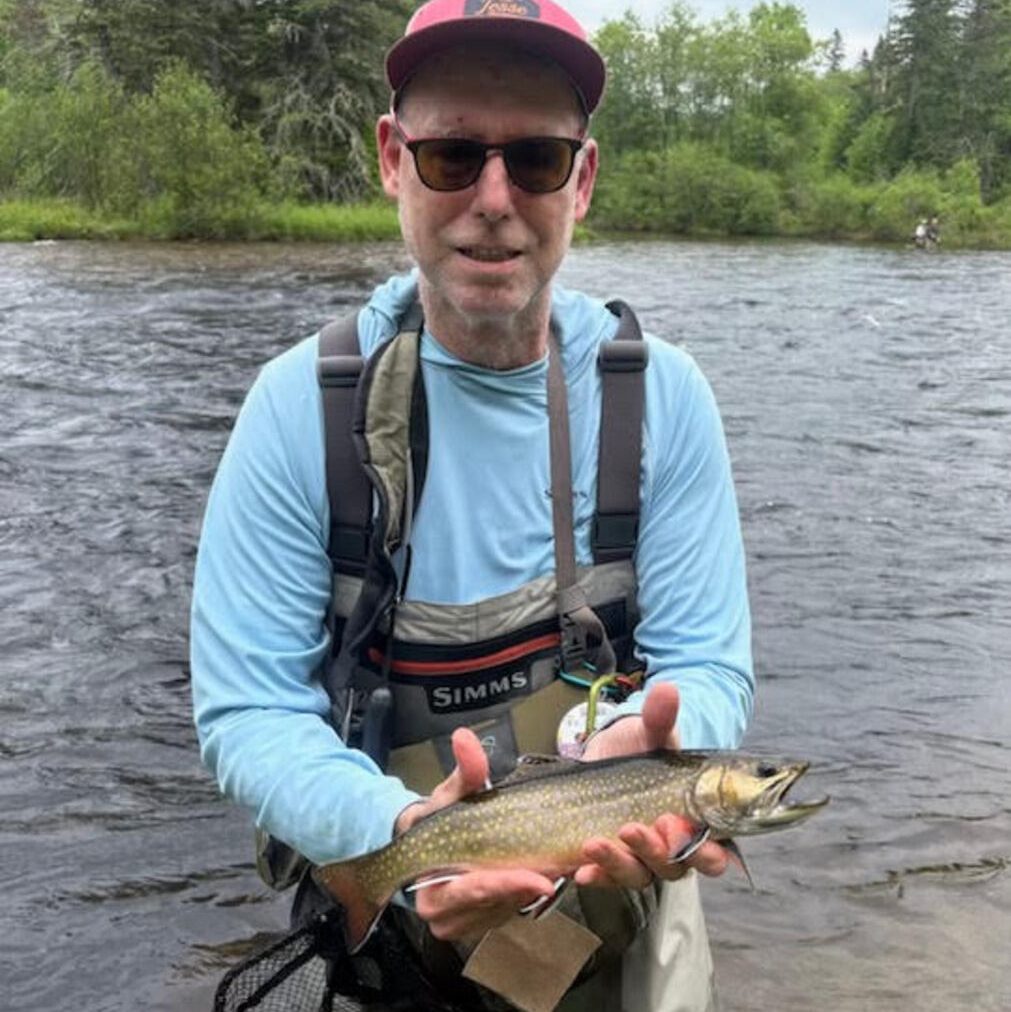

Besides who you choose to marry and where you decide to work, is there a more important decision than the choice of a fishing partner?
OK, there probably is, but it is still pretty important.
Bad weather, slow fishing, flat tires, poor accommodations and unanticipated disasters large and small are challenges that can test the bonds of any fishing friendship. Having the wrong partner can multiply the misery and disappointment. So, you should choose wisely.
What are the attributes you need to look for?
This first seems obvious, the guy or gal has to like to fish. That does not mean someone who likes the idea of fly-fishing as portrayed by Brad Pitt in “A River Runs Through It,” but wants to head back to the cabin if it rains fairly hard for half an hour. It does not include a guy who just wants to get away from his wife for a weekend or wants a place to drink in peace. If you are serious about fly fishing, you want someone who is equally committed and will not give up when the chips are down.
When I am on a legitimate fishing trip (as opposed to a quick hitter near my house on a Saturday morning), I want to be on the water eight or 10 hours a day, possibly more. My primary fishing partner, Robert, and I agree on this. Of course, if the fishing, or the weather, is abysmal, that is negotiable.

Robert displays a wild brook trout caught during a day of fly fishing in Maine. Credit: Courtesy of Marc McDonald 
A well-worn boat used by the author and his fishing partners sits beside a remote Maine pond. Credit: Courtesy of Marc McDonald 
Robert holds a salmon caught during one of many fishing trips he and the author have shared over the years. Credit: Courtesy of Marc McDonald
You want a partner who will challenge, even shame you a little bit about giving up early, but will ultimately relent if you are serious.
I admit that I am usually the first to run up the white flag of surrender when nothing good is happening. Robert is willing to stay on the water longer than I will in the face of what I believe is incontrovertible evidence that we are not going to catch a damn thing no matter how long we continue casting. But it takes me a reasonably long time to succumb to hopelessness.
That highlights the second necessary characteristic — flexibility. Both parties need to be willing to change plans, and go with the flow. That means sometimes accommodating the other person even if you are not totally on board with the plan. No two people will always agree on what they want to do and the manner in which they wish to do it. Sometimes you just have to grin and bear it.
Robert: “I know we have not caught anything fishing sinking lines from a canoe on this pond for three hours, but I think we should give it another 30 minutes.”
Me: “Sure.”
(Thought bubble: I would rather stick needles in my eyes, and my back is killing me…)
It is, naturally, helpful if you and your partner like the same type of fishing. If you love casting on rivers and your partner lives to troll streamers all day, it will probably be a short partnership. I love wade fishing in rivers. Robert likes that too, but he is also fine with pond fishing. Occasionally, I indulge him for the sake of our fishing marriage.
We do have in common the willingness to bushwhack for a couple hours for the payoff of catching some wild 8- or 9-inch brook trout. Not every fly fisher wants to chase small fish. Robert and I certainly like to catch big fish, but we have a shared appreciation for small, wild brook trout. But even we have our limits. Those limits were put to the test when we went fishing for a couple days at the Dartmouth Grant with our friend Jim a few years ago.
The Wentworth Location entrance to the Grant is almost literally across the street from the entrance to Middle Dam Road, which brings you to the Rapid River. And it is also very close to the Lower Magalloway. After spending a couple days chasing pretty but small brookies, the pull of those big waters with their big fish was pretty strong. Both of us were anxious to ply waters that held at least the possibility of larger fish.
It is also beneficial if you have different but complementary skills on the water. I consider myself a decent, if inconsistent, nymph fisherman. That is option one for me, absent rising fish, of course. But I am perfectly happy fishing dries or streamers.
Robert is a very good streamer fisherman. He usually starts with that method unless the water we are fishing is boiling with rises. By fishing different techniques, we let the fish tell us what is working.
Division of labor is also important. Everyone has to pull on the oars. We usually take Robert’s truck because it has more room than my Honda CRV. It also has a homemade rooftop rod carrier and a lockable rod drawer built into the back of his truck. So, he usually does the driving.
He knows more about boats and boating than I do, by a wide margin. He also can fix most anything, from broken rod tips to various types of machinery. I lack that gene.
Consequently, he does most of the rowing and motoring (and all of the small engine repair) when we are in a vessel. He is a first-rate navigator of back roads and “not quite roads.” And then there is his cooking…
That raises the question, what do I bring to this partnership?
I wash dishes. I usually sweep out the wall tent or cabin when we clear out. And of course, I am a joy to be with except when I have been skunked. That has to count for something.
On a more practical level, I tend to be the one who researches places to stay and makes the arrangements. I tie more flies in a greater variety than Robert does, so occasionally I can give him a hot fly which is somehow not in his pile of craft boxes filled with flies that he buys for 32 cents a dozen from God knows where on the internet.
And perhaps my biggest contribution, I am always up for a fishing trip. If I am not precluded by work or family obligations, I am there.
Did I mention I do dishes?