



I needed to recalibrate my expectations as a fly fisherman.
I recently returned from a trip to the Bighorn River in Montana. There, one has reasonable prospects of catching several, even “lots” of wild, very hard-fighting, 16- to 18-inch rainbows and browns, each day you are on the water.
As a New Englander who will never be confused for a world-class angler, this is not my normal lived experience. I fish the Rapid and Lower Magalloway as often as I can. Thus, I surely audition my flies to 16- to 18-inch brookies or salmon from time to time. Yet the notion of me hooking five, six, or ten salmonids of that size in one day is merely a pipe dream.
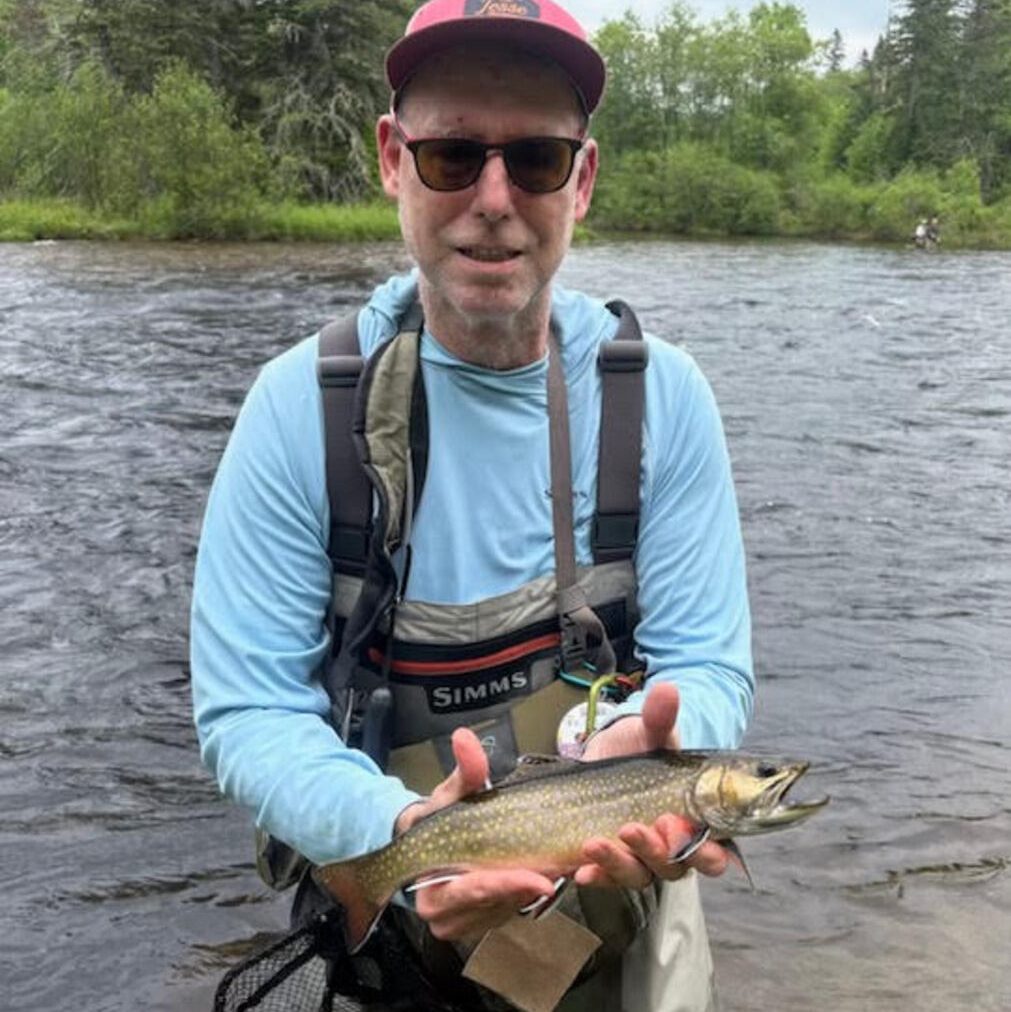
Then too, I needed to return to self-sufficiency. I avidly circulated hero shots of me holding nice trout that I caught out west, but let’s be real. I was in a drift boat under the tutelage of superior guides.
Those guides rigged the rods that I used, picked the nymphs to connect to the leader, and set the depth of the strike indicator. They controlled the course we took down the river, told us which bank to cast toward and decided what pools to back-row so we could float through them again.

Granted, I had to make decent casts, hook the fish and successfully play it (which I sometimes failed to do), but I was mostly leveraging my guide’s expertise. Don’t get me wrong, I enjoy concierge fishing at bucket list destinations, but unless I want to limit my fishing to a week every couple or three years, I need to fish locally, stand on my own two feet and appreciate trout that can be subdued by a wispy 3-weight fly rod.
For me, that means blue-lining for small, native brook trout in and around the White Mountains. These are bony, boulder-strewn trickles, often only eight or ten feet wide. Little ribbons of water, where a four-foot long, two-foot deep pool is cause for excitement. Reaching them usually requires some hiking and plenty of rock-hopping. Long casts are unnecessary, but you have to watch your backcast, or you will spend the day pulling flies from trees.
With a full canopy overhead, a short rod makes sense. Mine is a fiberglass, 3-weight Cabela’s CGR which started out at 5’9” but, thanks to reconstructive surgery performed by my friend Robert after I snapped off the tip, is now closer to 5’6”.
It’s a small, whippy noodle with a slip-ring reel seat. That last feature proved unfortunate. My reel fell off so often that I resorted to a modification that would probably mortify a rod builder — affixing a small cable tie at each end of the foot of the reel. It works and is a somewhat more aesthetically pleasing solution than duct tape.


A couple weekends ago, I packed my 3-weight, my mini net and a box of dry flies and headed north. I was accompanied by a new friend, Matt, who is active in the Native Fish Coalition. Unsurprisingly, he knows a few spots where native brookies might be found. We hit a couple of small unheralded brooks, the second of which had no established trail alongside it.
Access required some minor bushwhacking. In fact, even my companion, who has fished the brook several times, could not easily tell where he usually cuts into the woods to make his way upstream. It looks like an unbroken wall of leaves from the road. That’s a good thing, as far as I am concerned.
Once we found the well-hidden portal, we picked our way up a tiny, cold brook with just the right amount of current, little cascades and structure.
It’s a great way to spend a day. Wet wading, dry flies, and eager, if diminutive, native brook trout. You cannot help but be amazed by the survival skills and tenacity of these little brookies. I find comfort in simply knowing they are there.

Matt had to remind me not to overlook any water that is deeper than zero inches. By way of validation, when I stepped into a very slight depression in the stream bottom, in order to cast to a modest hole above it, a couple of trout bolted as soon as my wading boot hit the surface. The pool I had stomped through was maybe two-and-a half feet long, a foot wide and six inches deep. Lesson learned. Fish pretty much any water that is wet.
We immediately got into fish. The strikes were lightning quick, and I came up empty more than half the time. Most of the missed opportunities were a result of me being too slow to react, but some, I expect, could be attributed to trout which simply could not fit a size 14 fly into their tiny mouths.

The brook was full of three-to-five inch trout. Perhaps a couple could be recalled as six inchers if you did not break out the tape measure and get all scientific. They were eager, brightly marked and had intact fins with distinct white leading edges — a sure sign of trout which have never scraped the bottom of a concrete hatchery raceway. This was water where an eight-inch brookie would be a giant.
Of course, they are exactly “right-sized” for the confined environment in which they make their living.
As you might expect, fly selection was not complicated. Nonetheless, they clearly preferred Matt’s size 12 Royal Wulff to my size 16. My usual first choice, a size 14 orange-bodied elk hair caddis, got a lukewarm reception. I switched to a mini Chubby Chernobyl variation with a deer hair wing in place of the usual poly yarn, and that seemed to do the trick.
Earlier in the day at the first brook we visited, we fished a nice plunge pool. Matt caught an eight-inch Leviathan on a “usual” fly. Could it have been nine inches? If I had caught it, I would say “yes.”

We ended the day on a relatively large pool that may have been three feet deep and had a good census of uninhibited trout. Here, the orange-bodied elk hair caddis managed to redeem itself. I caught a few, the last being a five incher that rocketed a great distance to intercept my offering and struck it with unbridled enthusiasm.
I saw the entire ambush as clear as day and have been replaying it in my head ever since. I did manage to land the trout, and Matt and I agreed that was a good time to conclude our excursion. I declared it my best trout of the day, though I caught a slightly larger specimen of perhaps six-and-a-half inches at the first brook that we fished. That “big one” put a pretty good bend in my very limber 3-weight rod, but my last fish took the gold medal on style points.
Calling small wild brook trout “little jewels” is a well-worn cliché. I may have first encountered the phrase in one of John Gierach’s fine books — possibly “Even Brook Trout Get the Blues” — though I cannot be sure, having read nearly all of his work. In any event, whether or not he coined it, I cannot improve on the description.
It felt good to be back on my home waters — a great day which brought with it a healthy dose of perspective.