



I do not like being in a crowd when I have a fly rod in my hand. I recall seeing pictures of the Salmon River in upstate New York decades ago, showing fishermen in picket lines clogging the banks, like opposing armies separated by a watery no-man’s land. Combat fishing, some call it.
Whatever its name, I instantly knew it was not for me. I will gladly catch smaller fish in exchange for some solitude.
So, booking a trip to the Bighorn River might seem like an odd choice. I had never visited the Bighorn but was aware of its reputation as a busy fishery. Yet my fear of being able to cross the river from bank to bank using the bows of drift boats as stepping stones was quelled by reports of 3,000 to 4,000 trout per mile. Testimony from an acquaintance who has fished the Bighorn several times and keeps coming back also eased my concerns. Pictures of chunky Bighorn trout in fly-fishing magazines overcame my reservations. Off to Fort Smith, Montana.
I stayed at Kingfisher Lodge with my two sons, son-in-law and two good friends. It was more high-end than usual for a fisherman who tends toward DIY excursions to the Rapid, the Lower Magalloway and the West Branch. But the confluence of my 65th birthday and a large stockpile of credit card points had me pulling the trigger on the trip.
If you can swing it, I would highly recommend it. From general manager Shalon Hastings to the kitchen staff and the guides, everyone at Kingfisher is first-rate and really goes the extra mile for guests.
Then there is the river.
Its trout are abundant, strong and larger than the salmonids that usually find themselves connected to my flies. The scenery around the Bighorn is a mix of rolling plains, foothills and red cliffs. Austere to the eyes of a New Englander, yet beautiful in its own way.

There was no shortage of drift boats on the water, but the guides seem to have worked things out. Everyone found some space. There were long stretches during the first of our two floats when we were alone on the stretch of river we were fishing. Not so much on our second day, but we actually boated more fish on day two.
Our group included six people with widely varied degrees of experience. Thanks to knowledgeable and persistent guides, we all caught fish, including a 23-inch brown caught by my son-in-law on the third day of his fly-fishing career. Not only does he have a picture of the fish, he has a photo of the guide measuring it. He may be spoiled for fishing anywhere else.
I had tied some PMD dries, as my internet research suggested those might be on the menu, but alas, they stayed in my fly box. Two nymph indicator rigs were the order of the day, with size 16 or 18 sowbugs in the starring role.
Our fish counts were not gaudy, partly because some rainbows were still on redds and the guides quite properly avoided fishing those spots. I also learned that the fish census was down to “only” 1,500 trout per mile due to consecutive high water years which deposited silt on redds smothering some trout eggs.
The guide I spoke to about it believed that it was more of a dam management issue than a weather problem. I suppose none of that helped our efforts. Then again, the most obvious reason for our somewhat modest numbers was operator error — missed strikes and mistakes playing fish.
Though short — two days of fishing — it was a great trip. But it was not all sweetness and light. There was at least one challenge — the moss.
This well-known feature of the Bighorn takes some getting used to. It is ubiquitous and always plays with your mind (am I not getting hits because there is moss on my sow bug?). The guides school you on the Bighorn Slap and Bighorn Banjo, two rituals which help to de-moss your flies, shortly after you step into the drift boat.
Even if you do it right, you will spend some time picking moss, often large clumps of it, from your flies and your leader as you float through good water. It is undoubtedly a bit of a pain, but one needs to take the bad with the good.
The lavish weed/moss growth is the sign of a fertile fishery. And it provides first-rate housing for sow bugs, scuds and other aquatic insects. Without the weeds harboring a burgeoning population of insects, it is likely your sow bug patterns would not get eaten. I will take that trade-off.
So how did I do, really? I fished both days with my son Patrick. We caught about six or seven trout each on day one. Had we been quicker on our hooksets and more diligently followed our guide’s instructions, we could have doubled that number. But the fish were bigger than I usually catch and they had an abundance of fighting spirit.

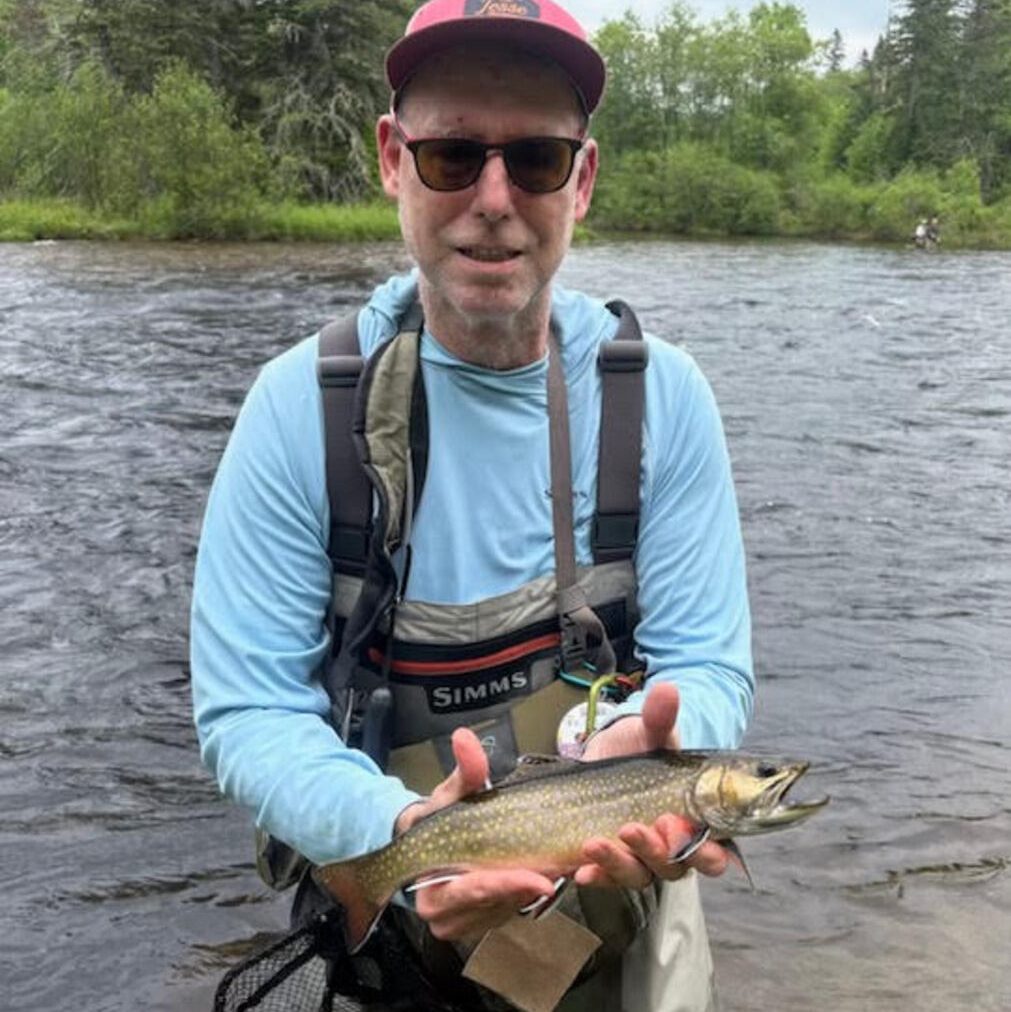
That included my personal-best brown trout and rainbow, which are pictured. Granted, I rarely encounter rainbows and browns because I usually chase brookies and landlocked salmon, but those are great fish pretty much anywhere.
On day two we caught about ten apiece, but once again, we could have put a few more on the board if we were really on the ball.
Naturally, there is a story about “the one that got away.” But the trauma is too fresh for me to commit the details of that episode to writing right now.
Lessons learned
I feel like I learn something, or at least get an idea to chew on, every time I go out with a good guide. This trip was no exception. One of our guides was using 3X fluorocarbon tippet to tie on size 16 or 18 sow bug patterns (using a bend-to-bend connection, no dropper tags). There was no shortage of takes, which makes me wonder if we obsess a bit too much over leader size.
Second, both guides used barrel swivels in place of a tippet ring on their nymph rigs, explaining they thought it prevented line twist. One of them placed three tungsten beads (small hole down) above the swivel to help get the flies down. I can’t be positive, but they looked like ⅛-inch “Firehole” Stones fly-tying beads in the Almond Joy color. Why wouldn’t that work on the Rapid or the West Branch?
Although I am on the “back nine” in terms of age, the life expectancy tables suggest I should have a chance to get back to the Bighorn. I hope to make it happen.